Disclaimer: This post was translated into English by an AI model. It may contain mistakes or awkward wording. A long quoted passage from the book is summarized rather than translated in full.
Gödel, Escher, Bach: An Eternal Golden Braid is a fascinating book that is hard to put down. I hope this short reading note can make more people interested in it.
When you first open the book, you may be shocked by Douglas Hofstadter's breadth of knowledge. He moves freely among music, art, logic, computation theory, linguistics, and biology, and his writing is extremely supple. I know little about Bach's music or Escher's art, but Hofstadter can convey the intrinsic similarities among different art forms through clear and accessible prose. It is eye-opening and hard to stop reading. But what exactly is this book about? Is it popular science about mathematics, computer science, AI, and logic?
My personal summary is that the core of the book is human cognition, the nature of thought, and its reproduction, namely the realization of artificial intelligence. Hofstadter identifies mysterious self-reference and recursion as the key, and from there begins an odyssey through mental space.1
Overview
The book has two parts.
- The first part lays theoretical foundations for the reader, introducing formal systems, recursion, primitive recursion, completeness, consistency, recursiveness, recursive enumerability, coding, and many other concepts at high speed. It culminates in Gödel's incompleteness theorem.
- The second part is the reason Hofstadter wrote the book. He tries to discuss the nature of thought and intelligence, criticizes naive spiritualism and mechanism, and presents his own relatively optimistic view.
This section only records my impressions of the writing; it is not a summary and inevitably misses much. If you want a more comprehensive content outline, the table of contents is already carefully organized.
Part One
I already knew the theory introduced in the first part quite well, so I read it very quickly, almost as a comparison with ideas already in my head. What is precious is that Hofstadter does not skip careful explanations just because the material is foundational. Textbooks often place such material in a preliminary chapter and list all the tools that will be used later. Hofstadter sacrifices some technical detail, but his metaphors are frequently accurate and illuminating, and his exploration of each concept often reaches surprising depth. The book undoubtedly covers every important result needed for an introduction to mathematical logic. Even when I already knew those results, I often learned a different perspective.
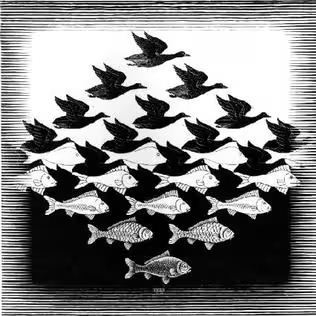
For example, Chapter 3, "Figure and Ground", discusses the generation of "non-theorems".2 If we regard the theorems generated by a formal system as a figure, then the part it cannot generate is the ground. Just as a ground is not necessarily itself a figure, we also cannot always construct a new formal system whose theorems are precisely the non-theorems of the original system. But sometimes the ground really is a figure, and correspondingly we obtain recursive systems.
Part Two
The second part begins by continuing the discussion of formal systems, but the focus clearly shifts toward the human mind. Hofstadter leaves behind the purely formal discussion of the first part and brings in more humanistic flavor, asking what knowledge is, how thought works through layering and modularity, and what counts as intelligence. He clearly believes the brain is governed by formal systems, but because of layering, we are only conscious of upper-level "symbols" and cannot reach the low-level mechanisms. He discusses very deep questions: why humans can discuss themselves while formal systems have difficulty doing so; why humans can modify their own patterns of thought; whether we can really jump out of our own world. He ends humorously: perhaps we are all characters in a novel, but would that affect our free will? The book does not explore the final question; perhaps it leaves an exercise for philosophy enthusiasts.
Here we can see the confusion and reflection of early and mid-period AI researchers. After 2016, AI approaches centered on deep learning came to dominate, while approaches based on reasoning and pattern recognition declined. AI systems have achieved superhuman results in more and more areas, but at the same time, has our understanding of thought become deeper than the understanding of the era in which this book was written?

The examples in this part are also the most interesting. To develop his argument, Hofstadter not only explores the limitations of formal systems, but also compares the central dogma of formal systems with the central dogma of biology. They are, astonishingly, similar. I believe this section contains many of Hofstadter's own views, as well as views absorbed from predecessors. For example: human intelligence is closely related to human language; one might even say that automatic translation is equivalent to implementing intelligence.
The book mentions a biological fact that I think is worth writing down: the simplest self-replicating system, the cell, far surpasses the most elaborate self-replicating system humans have designed, which in practice barely counts as a system. Programmers may have written quines: programs that output their own source code. If we treat a cell as a computer and DNA as the source code of software, then DNA not only describes the program, namely proteins; it also describes the program that copies the program, namely DNA replication; and it describes the construction of the computer that constructs the copying program, namely the rest of the cell. Most astonishingly, this whole system actually works. In computer terms, the source code would describe not only its own copying and a compiler, but also the process of building a new computer containing the same program.
After reading this part, I felt that intelligent systems are quite likely to be realizable, but if we want to realize them elegantly, perhaps we do not have many choices. The reason is simple: there is only one set of physical laws. A ribosome in amino-acid soup can easily catch tRNA and build a polypeptide, while computers in a clean room may not find it so easy to catch wafers.
Language and Parable
Among the many schools of classical Chinese thought, I especially love Zhuangzi. This is not because his philosophy resonates with me so much, but because his prose is excellent. As a book that ought to transmit thought, the strange imagination, interesting stories, and gorgeous language of Zhuangzi have influenced Chinese readers for thousands of years.
Although Hofstadter is American, GEB is absolutely comparable in this respect. The Chinese translation deserves much credit; almost no sentence is hard to understand. Personally, I would rather believe the book is a collection of fairy tales, with all the "main text" merely commentary on those tales. No wonder it won the Pulitzer Prize. Of course, the main text's subtle and fitting analogies among music, art, and logic are also wonderful.
Almost all of the stories are interesting, but I think the most marvelous one is the passage involving Babbage, Achilles, the Crab, the Tortoise, and Turing. In it, Babbage programs an "Intelligent Machine" to simulate Turing, Turing appears to answer back, and the dialogue spirals into a layered Turing test in which it becomes increasingly unclear who is the programmer, who is the program, and who is inside which reality. The scene ends with a beautifully absurd reversal: the figures inside and outside the screen seem to swap places, while each participant insists that the test belongs to the other. It is a perfect miniature of the book's obsession with self-reference, simulation, and the instability of the boundary between symbol and meaning.
On language, it is especially worth mentioning that Hofstadter treats form and content as equally important, and therefore designs many language games. Appreciating the formal beauty alone is also one of the pleasures of GEB. At the same time, the linguistic form perfectly echoes the content. We should also notice that one of the book's major concerns is how to grasp content from form,3 and it finally lands on the idea that the brain is a formal system and that perhaps we can implement such a formal system. This threefold unity of form and content is irresistible.
What Is Missing
Although Hofstadter does his utmost to make the text easy to understand without losing rigor, some statements are still rather abstruse. Again in Chapter 3, he says that "there exist recursively enumerable sets which are not recursive." I am certain that readers encountering this for the first time will be confused. It is a completely new concept, yet it has deep implications.
The book's greatest weakness may simply be that it is old. GEB is a book from the 1970s. At that time, IBM's Deep Blue had not yet defeated chess world champion Garry Kasparov. Even after hearing of that event, Hofstadter did not change his view: that was not real intelligence. I can fully understand the perplexity of AI pioneers. Why can AI do more and more things while seeming farther and farther from general intelligence? Do we have no idea what intelligence is, and merely keep clarifying what intelligence is not? But what about the approaches based on statistics and optimization that have dominated the last decade? What would Hofstadter think of them? I urgently want an answer.
Should I Read This Book?
It is not only people who choose books; books also choose people. Although many people, like me, love GEB, others think it is empty and unoriginal. I will not adjudicate that. I still strongly recommend that you read it, because what if you find it wonderful?
- The book is completely self-contained. As long as you have curiosity, you can finish it, so do not worry too much about lacking background knowledge. After all, it is only more than a thousand pages.
- For readers unfamiliar with logic: the first part is not a textbook of mathematical logic, so it is better not to read it with the goal of "learning new knowledge", but with the attitude of "discovering a new perspective". Readers encountering mathematical logic for the first time may find it shocking, but all textbooks in mathematical logic can produce a similar effect, and simply skimming this book will not give a solid understanding of the concepts.
- For readers familiar with logic: I already knew more or less all of the techniques discussed in the book, so it is hard to say I learned new technical content. But merely seeing the author express, so exquisitely, fragments of ideas I had wanted to express but could not, was extremely satisfying.
If you only want to understand Gödel's incompleteness theorem, this book is definitely not written for you. It is better to choose another book.
"A Mental Space Odyssey" comes from an MIT public course on GEB for high-school students.
Here "non-theorems" means statements that the system cannot generate, not statements of the form \(\lnot p\) that the system can generate.
The book discusses first-order logic in some detail and points out that first-order formal arithmetic has no unique model. It even gives a concrete model of \(TNT + \lnot G\), making the pessimistic suggestion that truth may in fact be arbitrary. Later it hints that perhaps the brain uses a different logic. In second-order logic, all models of the Peano axioms are isomorphic; does this give us some comfort?